Who this is for
Business owners, marketing managers, and entrepreneurs in Qatar who want to understand the web design trends that actually matter for their market — and what to do about them.
Website design in Qatar is moving towards clean, premium, and conversion-focused experiences. Businesses are choosing websites that look modern, load fast, and work smoothly across all devices. In 2026, design is not only about appearance — it is about performance, trust, and user experience.
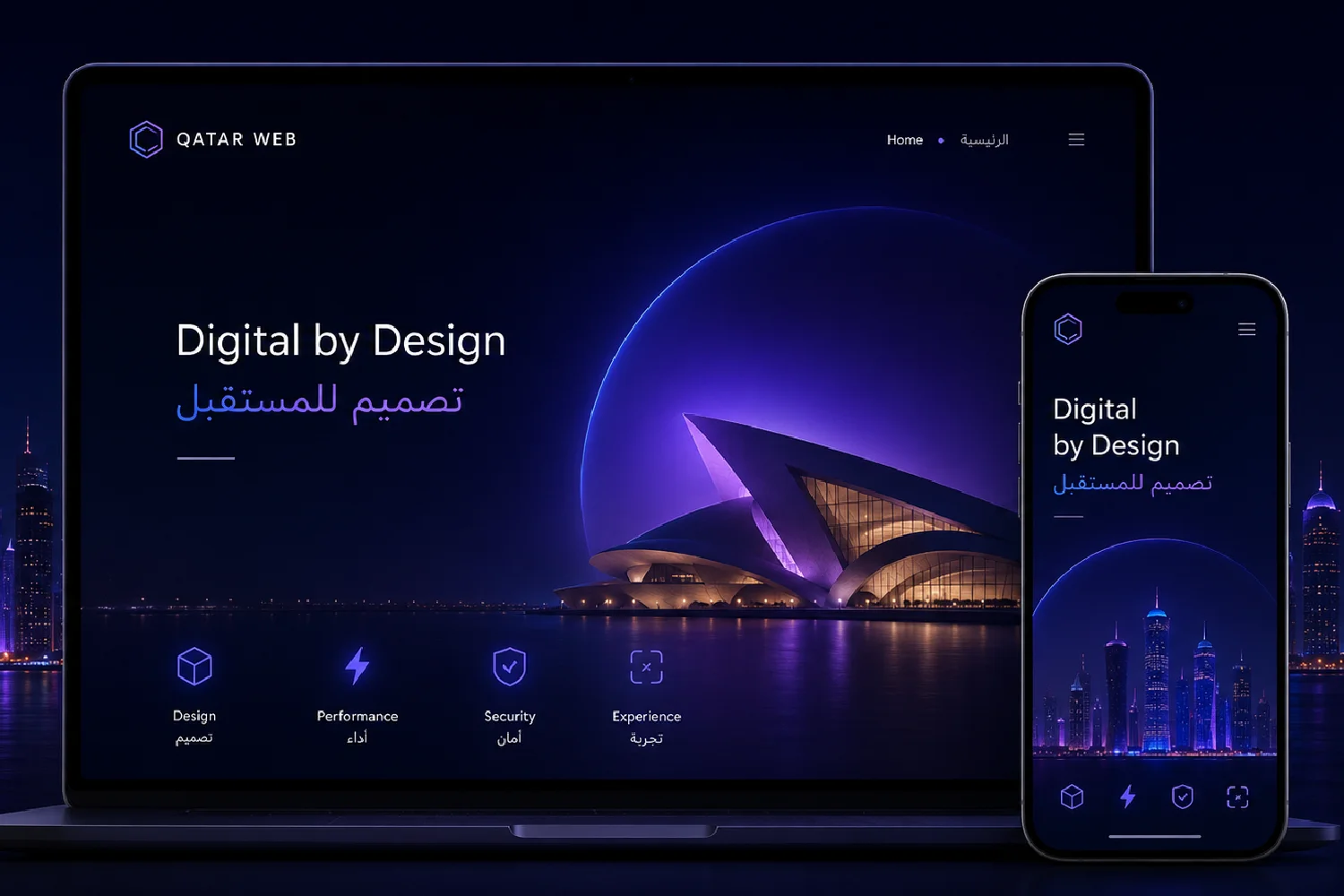
One major trend is dark mode design, especially for technology, luxury, real estate, and creative brands. Minimal layouts, bold typography, micro animations, and premium color palettes are also becoming popular. Bilingual website design is another important trend in Qatar because many brands need both English and Arabic content.
AI-powered website design is also growing. From smart content sections to chatbot integration and personalized user journeys, AI helps websites become more useful and interactive.
Trend 1: AI-Powered Personalisation
Artificial intelligence has moved from buzzword to genuine website infrastructure. In 2026, leading websites in Qatar are using AI to serve personalised content, product recommendations, and dynamic CTAs based on visitor behaviour, location, language preference, and device type.
What this means for Qatar businesses
A visitor browsing your site on a mobile device in Doha at 9pm should see a different experience than a desktop user in West Bay during business hours. AI-driven personalisation makes this possible — and in Qatar’s competitive market, businesses that personalise are converting at significantly higher rates than those that don’t.
- E-commerce sites are showing Arabic-language content and local payment methods automatically to Qatari visitors.
- Service businesses are surfacing relevant case studies based on the visitor's inferred industry.
- Hotels and restaurants are serving different promotions to returning visitors versus first-time arrivals.
Quick Win
Even without a full AI engine, you can start with simple personalisation: a WhatsApp CTA that pre-fills a message based on the page the visitor is on, or a language toggle that remembers the user’s preference across sessions.
Trend 2: Mobile-First, Then Mobile-Only
Mobile-first has been the standard for several years. In 2026, the most forward-thinking Qatar businesses are going further — designing the mobile experience as the primary product, and treating desktop as the secondary consideration. Qatar’s mobile internet usage now accounts for over 75% of all web traffic, a figure that continues to climb.
The business case
Google’s Core Web Vitals — the performance benchmarks that directly influence your search ranking — are measured on mobile. A site that performs beautifully on desktop but loads slowly or feels clunky on mobile is actively penalised in search results. For businesses in Qatar trying to attract organic traffic, mobile performance is not optional.
- Thumb-friendly design: all interactive elements (buttons, forms, menus) designed for one-handed thumb use.
- Persistent floating WhatsApp button: visible on every mobile page, removing friction from the most-used communication channel in Qatar.
- Accelerated load times: mobile pages loading in under 2 seconds, achieved through optimised images, lazy loading, and clean code.
- Simplified navigation: single-level hamburger menus that do not frustrate or confuse mobile users.
Trend 3: Dark Mode as a Design Standard
Dark mode has graduated from a novelty to a genuine design requirement. In Qatar’s climate — where many people browse on their phones in low-light settings or outdoors in glare-heavy environments — dark mode offers real practical benefits: reduced eye strain, better screen visibility, and a premium aesthetic that resonates with Qatar’s design-conscious market.
Implementation for Qatar websites
The most sophisticated approach in 2026 is not simply inverting colours, but designing dual theme systems from the ground up — where both the light and dark versions feel intentional, premium, and on-brand. Many of Qatar’s leading hospitality, luxury retail, and technology brands have already adopted dark-mode-first design systems.
- Automatic switching based on the user's device theme preference.
- Manual toggle allowing users to switch on demand.
- Dark-mode optimized imagery: photographs and graphics designed to look equally strong on both dark and light backgrounds.
- Simplified navigation: single-level hamburger menus that do not frustrate or confuse mobile users.
- Brand consistency maintained across both modes with carefully selected accent colours.
Trend 4: Arabic-English Bilingual Design
Qatar’s population is uniquely multilingual. Approximately 85% of residents are expatriates from over 100 nationalities, while Qatar’s national identity and government communications are firmly rooted in Arabic. A website that serves only one language is immediately limiting its reach and relevance in this market.
Beyond translation — genuine bilingual design
The key distinction in 2026 is between websites that are translated and websites that are truly bilingual. Translation means taking an English website and converting the text to Arabic. Bilingual design means building a website where both languages are first-class citizens — with proper RTL (right-to-left) Arabic layout, Arabic-appropriate typography, culturally relevant imagery, and a seamless language switch that transforms the entire layout, not just the words.
- RTL layout switch: the entire page layout mirrors when Arabic is selected — navigation moves to the right, text aligns correctly, and reading flow is natural.
- Arabic typography: selecting typefaces specifically designed for Arabic script that match the quality of the English typeface used.
- Cultural sensitivity: imagery and colour choices that work respectfully across both Qatari national culture and the diverse expatriate community.
- SEO in both languages: separate Arabic URLs and meta content to capture Arabic-language searches on Google.
Market Opportunity
Over 40% of Google searches in Qatar are conducted in Arabic. Businesses with properly optimised Arabic websites are capturing a significant share of organic traffic that English-only competitors are completely missing.
Trend 5: Micro-Animations and Purposeful Motion
The era of static websites is over. In 2026, the most effective Qatar business websites use subtle, purposeful animations to guide user attention, communicate state changes, and create a sense of quality and polish that static designs simply cannot achieve.
Purposeful, not decorative
The critical distinction is between animation that serves the user and animation that serves the designer’s ego. Trends that work in Qatar’s market are those that make the website feel more intuitive and responsive — not those that slow down load times or distract from conversion goals.
- Button hover states: subtle colour shifts and scale transforms that confirm interactivity.
- Scroll-triggered reveals: sections and content blocks that animate into view as the user scrolls, creating a sense of progressive disclosure.
- Loading states: skeleton screens and progress indicators that make perceived wait times feel shorter.
- Form feedback: immediate visual confirmation when fields are filled correctly or incorrectly.
- Navigation transitions: smooth page transitions that feel like a native app rather than a traditional website.
Trend 6: WhatsApp-First Contact Strategy
No design trend in this list is more specific to the Qatar and Gulf market than this one. WhatsApp is not merely a popular messaging app in Qatar — it is the primary communication channel for business enquiries, customer service, appointment bookings, and sales conversations across virtually every industry.
Building WhatsApp into the design architecture
The most effective Qatar websites in 2026 treat WhatsApp as a first-class conversion element — not an afterthought. This means designing the entire contact strategy around the expectation that visitors want to reach you on WhatsApp first, and making that path as frictionless as possible.
- Persistent floating WhatsApp button: visible on every page, always accessible regardless of scroll position.
- Pre-filled message templates: the WhatsApp link opens with a pre-written message relevant to the page the visitor was on ('Hi, I'm interested in your web design services').
- WhatsApp in the navigation: a dedicated WhatsApp icon in the main navigation bar alongside the standard contact link.
- Business hours indicator: showing whether the team is currently available on WhatsApp, setting expectations and reducing frustration.
- WhatsApp QR code on contact pages: allowing visitors to scan and connect without typing a number.
Conversion Insight
Testing across Qatar-based websites consistently shows that WhatsApp CTAs outperform traditional contact forms by 3:1 in terms of enquiry volume. In industries like construction, hospitality, and professional services, the ratio can be even higher
Trend 7: Performance-First Development
Website speed has always mattered. In 2026, it matters more than ever — both as a direct ranking factor in Google search results and as a conversion driver. Research consistently shows that a one-second delay in page load time reduces conversions by 7%. For businesses in Qatar investing in paid advertising, a slow website is burning money on every click.
Core Web Vitals in the Qatar context
Google’s Core Web Vitals — Largest Contentful Paint (LCP), Interaction to Next Paint (INP), and Cumulative Layout Shift (CLS) — are the technical benchmarks that determine whether Google considers your site fast enough to rank well. Achieving strong scores on all three requires deliberate technical decisions from the first line of code.
- LCP under 2.5 seconds: the main content of the page loads quickly, achieved through optimised images, fast hosting, and minimal render-blocking code.
- INP under 200ms: the page responds to user interactions immediately, without perceptible lag.
- CLS below 0.1: the layout does not jump or shift as the page loads, preventing the frustrating experience of accidentally tapping the wrong element.
- Hosting in the region: choosing hosting infrastructure in the Middle East or Gulf region significantly reduces latency for Qatar-based visitors.
Trend 8: Conversion-Optimised Landing Pages
Businesses in Qatar that are running Google Ads, social media campaigns, or influencer partnerships are increasingly recognising that sending paid traffic to a generic homepage is a waste of budget. In 2026, dedicated landing pages — designed around a single product, service, or offer with one clear conversion goal — are delivering dramatically better returns.
What makes a high-converting landing page in Qatar
The anatomy of an effective Qatar landing page follows a proven structure, adapted for local market expectations:
- A compelling, specific headline that addresses a known pain point or desire.
- Social proof immediately visible above the fold: client logos, Google star rating, or a strong testimonial.
- A single, prominent CTA — ideally a WhatsApp button or short enquiry form, not both.
- Trust signals: local address, phone number, professional photography, and any relevant certifications or awards.
- Mobile-optimised layout with fast load speed — especially important if traffic comes from social media, which is predominantly mobile.
Trend 9: Local SEO and Qatar-Specific Content
Global SEO strategy and Qatar SEO strategy are not the same thing. Businesses that apply generic international SEO advice to their Qatar websites often fail to capture the most valuable searches — those with clear local intent from people who are physically in Qatar and ready to buy.
Qatar-specific SEO priorities in 2026
The anatomy of an effective Qatar landing page follows a proven structure, adapted for local market expectations:
- Google Business Profile: a fully completed, regularly updated GBP listing is often the single most impactful SEO action for local Qatar businesses — appearing in the map pack drives significant walk-in and call traffic.
- Location-specific landing pages: separate pages for different neighbourhoods or areas (West Bay, The Pearl, Lusail, Al Wakra) allow businesses to rank for hyper-local searches.
- Arabic keyword optimisation: researching and targeting the specific Arabic search terms used by Qatari nationals and Arabic-speaking residents.
- Schema markup: structured data that helps Google understand your business location, services, prices, and reviews — improving rich snippet visibility in search results.
- Local link building: mentions and links from Qatar-based publications, business directories, and community websites carry disproportionate value for local rankings.
Trend 10: Minimalism with Cultural Premium Aesthetics
Qatar’s market occupies an interesting design tension: the country has a strong cultural preference for quality, luxury, and craftsmanship, yet the most effective digital designs in 2026 are those that communicate premium through restraint rather than excess. Less is more — but the ‘less’ must be executed with exceptional precision.
What this looks like in practice
The premium minimalist aesthetic that resonates in Qatar’s market is characterised by generous white space, precise typography, high-quality photography, and a limited, confident colour palette. Websites that try to impress through visual complexity — multiple competing colour schemes, crowded layouts, excessive animation — read as amateur compared to those that achieve impact through simplicity and quality.
- Typography as design: choosing two complementary typefaces — one serif for headlines, one sans-serif for body — and using scale and weight to create hierarchy without relying on colour.
- Hero photography: investing in genuinely high-quality, original photography of your team, premises, or work. Stock photography is immediately recognisable and undermines credibility.
- Generous whitespace: allowing content to breathe. Dense, cluttered layouts feel low-budget regardless of their technical execution.
- A single strong accent colour: one brand colour used consistently and sparingly throughout the design, rather than multiple competing colours vying for attention.
2026 Trend Summary
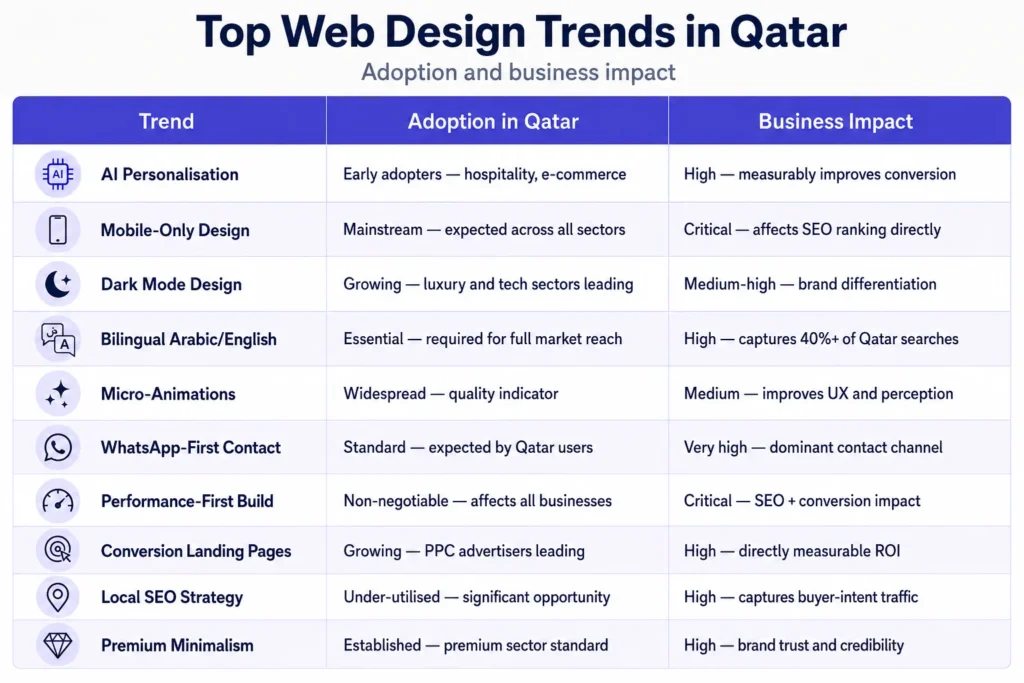
A quick reference overview of all ten trends and their relevance for Qatar businesses:
What This Means for Your Business
Not every trend on this list is relevant to every business in Qatar. A family-run restaurant in Al Wakra has different priorities from a corporate law firm in West Bay or an e-commerce startup in Lusail. The starting point is always the same: a fast, mobile-optimised, bilingual website with clear conversion paths and genuine local SEO foundations.
From that foundation, the trends that matter most to your specific business depend on your audience, your budget, and your competitive landscape. The common thread across every trend in this list, however, is the same principle that has always separated effective websites from ineffective ones: build for your customer first, and the design will follow.
Ready to implement these trends?
Whether you need a complete redesign or targeted improvements to your existing website, we build websites specifically for the Qatar market — fast, bilingual, WhatsApp-ready, and SEO-optimised from day one. Contact us via WhatsApp or request a free consultation today.
About the author
This post was written by the web design team at WebFX,Qatar — a full-service web design and development agency based in Doha, Qatar, specialising in professional websites for businesses across the Gulf region.